For too long, training ignored the realities of women’s lives—the social conditioning, the hormones, the violence, the invisible labor.
And while more women are finding their voice, the work isn’t done. They’re still fighting to be taken seriously—to have their pain believed, their boundaries respected, and their needs prioritized in homes, workplaces, and therapy rooms.
At the Women’s Mental Health Summit, you’ll get the tools to change that.
With today's in-demand, groundbreaking speakers, you’ll explore the full spectrum of women’s mental health—through trauma-informed, somatic, neurobiological, and feminist frameworks that center women’s lived experience.
Featuring top voices in the field like:- Judith Lewis Herman — Challenge gendered power dynamics through relational, trauma-informed care
- Nedra Glover Tawwab — Release perfectionism and embrace interdependence with boundaries
- Sarah Hill — Integrate hormonal and neurobiological factors into mood and identity treatment
- Ann Saffi Biasetti — Apply somatic and compassion-focused tools for body image and self-trust
You’ll also gain strategies from nine other experts addressing intimate partner violence, gaslighting, sexual trauma and shame, self-abandonment, neurodiversity, and reclaiming pleasure—the realities too often left out of training.
You’ll walk away with evidence-based interventions drawn from ACT, DBT, CBT, MI, and more—designed to help women reclaim voice, power, and belonging in therapy and in life.
Therapy for women must be built on women’s lived experience.
Join us – save your spot today!
2026 Women’s Mental Health Summit:
Advancing Women’s Care with Science, Soul, and Transformative Clinical Practices9:00 AM – 5:45 PM Central Time
- Live, interactive sessions
- Real-time communication with speakers and peers
- 30-day on-demand replay access
- Earn up to 14 Live CE hours, including cultural competency credit
- Bonus sessions for additional learning and up to 2 self-study CE hours
- Unlimited on-demand access to every session
- Self-paced learning anywhere, any time
- All learning materials included
- Earn up to 14 self-study CE hours, including cultural competency credit
- Bonus sessions for additional learning and up to 2 self-study
CE hours
Without specialized training, therapy can
unintentionally harm women. It can look like...
- Seeing eating disorders as willpower issues instead of recognizing the impact of diet culture
- Blaming burnout on poor self-care while ignoring the gender pay gap and invisible labor
- Reinforcing self-neglect by applauding women’s high empathy for others
- Using subtle language that fuels shame around menstruation and menopause, leaving women without the care they deserve
Even well-meaning therapy can leave women clients feeling frustrated, invalidated, and isolated.
Join us for two powerful days of clinical training that will change the way you practice with women — helping you stop pathologizing what’s adaptive, treat the full context of women’s lives, and create therapy spaces where women feel truly seen, supported, and capable of change.
Learn from leading experts and walk away ready to use evidence-based tools in your very next session.
You're All-Access Pass Includes:
- Live, interactive sessions
- Earn up to 14 live CE hours, including cultural competency credit
- 30-day on-demand replay access
- Bonus sessions for additional learning and up to 2 self-study CE hours
Right now, you can secure your spot for just $299.99.
2026 Women’s Mental Health Summit:
Advancing Women’s Care with Science, Soul, and Transformative Clinical Practices9:00 AM – 5:45 PM Central Time
- Live, interactive sessions
- Real-time communication with speakers and peers
- 30-day on-demand replay access
- Earn up to 14 Live CE hours, including cultural competency credit
- Bonus sessions for additional learning and up to 2 self-study CE hours
- Unlimited on-demand access to every session
- Self-paced learning anywhere, any time
- All learning materials included
- Earn up to 14 self-study CE hours, including cultural competency credit
- Bonus sessions for additional learning and up to 2 self-study
CE hours
Few figures have transformed the trauma field like Judith L. Herman, MD—the psychiatrist whose groundbreaking Trauma and Recovery redefined trauma as not just a personal wound but a social and political one.
Now, in her powerful new work Truth and Repair, Dr. Herman reveals what survivors say they actually need to heal—and why justice, not silence, is the missing piece of recovery.
You’ll learn:
- Tools to center survivors’ own vision of justice—not impose one
- How to unpack the power dynamics of dominance, subordination, coercive control, and mutuality
- How to sensitively handle discussions about confronting and exposing perpetrators
- The profound impact of restoring connection with a "moral community," where healing and justice take root
Your women clients are stuck in harsh self-criticism—replaying mistakes, questioning their worth, and feeling overwhelmed by an inner voice that never seems to quiet. Negative self-talk isn’t just a mindset issue; it’s driven by brain networks shaped by stress, hormones, trauma, and lifelong social conditioning—and the nervous system pays the price.
In this session, you’ll get clear, brain-based tools to understand where negative self-talk comes from and how to treat it more effectively.
You’ll learn:
- How the DMN, CEN, and salience network drive patterns of self-criticism, anxiety, and rumination
- How gender-specific factors like fatigue, hormones, trauma, and social conditioning intensify negative self-talk
- How to match evidence-based and adjunctive interventions to a client’s neurobiological presentation
Having accurate information about the impact of hormones on mental health is crucial for working with women in therapy. From the fluctuations in mood, energy levels, and mental clarity that are baked into the menstrual cycle – to the symptom vulnerability that comes with the lifespan transitions of puberty and perimenopause – women’s sex hormones play an important role in the well-being of your clients.
In this session, Dr. Sarah E. Hill – award-winning researcher and author of the groundbreaking books This is Your Brain on Birth Control and The Period Brain – will show you what you need to know to provide hormone-informed treatment.
You’ll get:
- Cutting-edge assessment tools to uncover the impact of hormones on your clients’ symptoms
- Emerging evidence-based guidance around timing of treatment interventions to maximize effectiveness
- Strategies to support clients’ resilience to hormonal changes and nervous system regulation
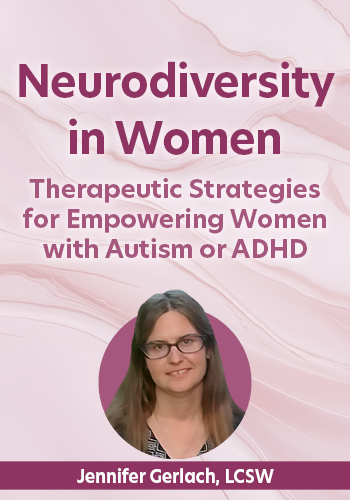
If you don’t know what to look for, it can be easy to miss. ADHD and Autism in women don't look
like the textbooks or the “typical” male-normed cases.
You need specialized skills so
that you don’t misunderstand or misdiagnose your neurodivergent women clients who are already at
high risk of a cascade of problems connected to low self-worth, including eating disorders,
relationship abuse, and suicide.
In this session, Jennifer Gerlach, LCSW – psychotherapist and neurodiversity expert – will help you give you an integrative toolkit for working with neurodivergent women.
You’ll get:
- Strategies to address core negative beliefs and build self-compassion
- A powerful values clarification exercise to improve clients’ self-relationship
- Techniques to empower neurodivergent women clients to self-advocate more effectively
Your women clients are doubting their memory, minimizing their instincts, and wondering if they’re “too sensitive.” Even when something feels wrong, gaslighting has taught them not to trust themselves—and the nervous system pays the price.
In this session, you’ll get clear, trauma-informed tools to help clients name gaslighting and begin repairing self-trust.
You’ll learn:
- How to distinguish gaslighting from conflict or miscommunication
- How gaslighting disrupts identity, attachment, and nervous system regulation
- Practical somatic and psychoeducational strategies to help clients re-anchor reality and rebuild confidence
This session gives you language, structure, and brief interventions you can use immediately to validate survivors, name what’s been invisible, and help women reclaim their sense of self.
Your women clients have been saying “yes” to everything and everyone. They’ve turned away from their own needs and gotten lost in others’. And even though they may feel the negative effects of exhaustion, depletion, and burnout – self-abandonment is a hard habit to break.
In this session, Drs. Avery Hoenig, Lucy Smith, and Jamie Wilson – authors of Overcoming Self-Abandonment – will give you the tools you need to help clients reclaim their identity.
You’ll learn:
- How to name the systemic forces that drive women to self-abandon
- Strategies to detect the subtle ways that women can silence their own needs and desires
- Powerful mindfulness, embodied awareness, and self-compassion practices to restore self-connection
You’ve tried to help them shift problematic behaviors and unhelpful thinking patterns, but your clients with disordered eating and body dissatisfaction still struggle. Every meal and every mirror is a stressor. And with the high risk of common dieting developing into a full-blown eating disorder, it’s time to shift your approach.
In this session, Ann Saffi Biasetti, PhD, LCWSR, CEDs, CIAYT – author of Befriending Your Body and The Awakening Self-Compassion Card Deck – will give you a new set of foundational skills in interoception and nervous system regulation to end your clients’ fear-based relationship with food.
You’ll learn:
- Tools to counter disembodiment and create a more compassionate connection to the body
- Skills to help clients focus on their internal experience over their external appearance
- Interventions that shift your clients from body distress to body respect
Your women clients may not name their experiences as “abuse,” yet they live with chronic hypervigilance, self-doubt, shame, and exhaustion. Coercive control, harassment, and subtle safety violations often hide in plain sight—and without careful intervention, even well-intentioned therapy can unintentionally increase risk.
In this session, Dr. Robyn Gobin equips clinicians with concrete, trauma-informed tools to recognize safety erosions across the continuum—from microaggressions and coercion to IPV and abuse—and respond with clarity and care.
You’ll learn:
- How to identify nuanced indicators of coercive control and gender-based safety violations
- How to assess safety and support regulation without escalating danger or blame
- How to use mindfulness, self-compassion, and CBT-based strategies in ways that protect survivor safety
Most women in therapy don't think they have a drinking problem-- and they're probably right by
traditional standards. They're not "alcoholics" – they’re exhausted and they’re over-functioning
and they’re using wine exactly as marketed: as self-care, as a reward, as their "off
switch."
And because alcohol serves such an important function, it’s hard for them to talk with you about
changing how much and how often they drink.
In this session, Amanda White, LPC, LMHC – author of the acclaimed Not Drinking Tonight and
creator of the popular Instagram account @therapyforwomen – will show you how to approach
gray-area drinking in a way that bypasses defensiveness and shame.
You’ll learn:
- Key curiosity-based questions to understand patterns of disordered drinking
- How to collaborative exploration creates more change than confrontation ever could
- Why moderation fails and what to do instead to break the perfectionism-exhaustion-wine-anxiety cycle
2026 Women’s Mental Health Summit:
Advancing Women’s Care with Science, Soul, and Transformative Clinical Practices9:00 AM – 5:45 PM Central Time
- Live, interactive sessions
- Real-time communication with speakers and peers
- 30-day on-demand replay access
- Earn up to 14 Live CE hours, including cultural competency credit
- Bonus sessions for additional learning and up to 2 self-study CE hours
- Unlimited on-demand access to every session
- Self-paced learning anywhere, any time
- All learning materials included
- Earn up to 14 self-study CE hours, including cultural competency credit
- Bonus sessions for additional learning and up to 2 self-study
CE hours
Watch Anytime On-Demand
Upend Shame & Stigma by Normalizing Women’s Collective (Yet Taboo) Experiences
Our stories hold the key to creating a more equitable and honest reality for us all. For far too long, the therapy office has seemed like the only safe space to explore common, yet taboo, female experiences such as: body image issues, sexual trauma, miscarriage, motherhood, fertility struggles, menopause, anxiety, depression, and so much more.
But what if more women spoke up about their hardships, struggles, and pain? What if… we could replace the antiquated silence with storytelling?
In this recording, you’ll hear an honest discussion between renowned Dr. Jessica Zucker – author of Normalize It: Upending the Silence, Stigma, and Shame that Shape Women’s Lives – and therapist and mental health influencer Israa Nasir – author of Toxic Productivity: Reclaim Your Time and Emotional Energy in a World that Always Demands More.
They'll dive into:
- How to shift toward more authentic and grounded conversations
- How to start speaking up about our important stories so that healing can begin
- How therapists can inspire their female clients to be that much more outspoken about the hard stuff
You won’t want to miss this rare opportunity to hear two of today’s leading experts in women’s issues connect around the important, unspoken issues.
We’re that confident you'll find this learning experience to be all that's promised and more than you expected.
2026 Women’s Mental Health Summit:
Advancing Women’s Care with Science, Soul, and Transformative Clinical Practices9:00 AM – 5:45 PM Central Time
- Live, interactive sessions
- Real-time communication with speakers and peers
- 30-day on-demand replay access
- Earn up to 14 Live CE hours, including cultural competency credit
- Bonus sessions for additional learning and up to 2 self-study CE hours
- Unlimited on-demand access to every session
- Self-paced learning anywhere, any time
- All learning materials included
- Earn up to 14 self-study CE hours, including cultural competency credit
- Bonus sessions for additional learning and up to 2
self-study
CE hours