This conference is designed for counselors, social workers, psychologists, marriage and family therapists, and other professionals who work with children and adolescents.
2026 Kids Trauma Conference: Healing the Past, Shaping the Future with Neuroscience, Attachment & Play
Trauma doesn't live in the past.
It lives in the way a child experiences the present—with a nervous system still primed for threat.
It seeps into relationships, interrupts development, and reshapes the beliefs that guide a child's life.
And when that child enters your therapy room, every moment carries weight. How you respond can reinforce patterns of fear—or open pathways to safety, resilience, and growth.
At the Kids Trauma Conference, we’re zeroing in on those moments—equipping you with tools that shift a child’s nervous system from protection to connection.
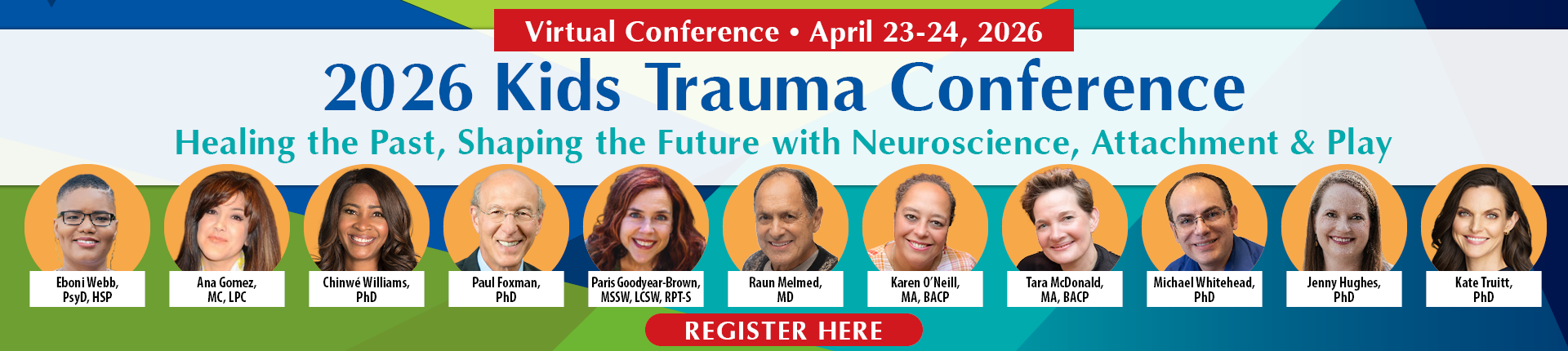
Join the world's foremost child trauma experts—Ana Gomez, Eboni Webb, Paris Goodyear-Brown, and many others as they share strategies including EMDR, creative therapies, somatic interventions, TraumaPlay (TM), MI, and additional skills that make every session count.
You'll learn to:
- Break generational cycles of trauma and foster secure parent–child connections
- Apply a holistic framework with practical tools that strengthen resilience within the overlapping pathways of prenatal exposure and trauma
- Identify behaviors that signal internalized perpetrator dynamics
- Leverage the Window of Tolerance to approach dissociation with clarity and confidence
- Understand vagal tone reversal and its role in explosive trauma responses
- And more!
PLUS, upon completion of this event, you'll also be eligible to become a Certified Child and Adolescent Trauma Professional (CATP)—at no additional cost to you—adding valuable skills and credentials to your resume.
Register now!
Kids Trauma Conference
Healing the Past, Shaping the Future with Neuroscience, Attachment & Play
LIVE Online April 23-24, 2026
Join Us Live Online
All-Access Pass
Valued at $1,369.89 — $299.99
REGISTER NOW
Valued at $1,369.89 — $299.99
- 30-day on-demand replay access
- Real-time communication with speakers and peers
- 2 Bonus sessions
- Earn up to 15.5 live CE hours and 3.5 self-study CE hours
Can't Attend Live?
Get the Complete Recording Package
Valued at $1,369.89 — $299.99
REGISTER NOW
Valued at $1,369.89 — $299.99
- Unlimited access to every session
- Self-paced learning anywhere, any time
- 2 Bonus sessions
- Earn up to 19 self-study CE hours (CE details available 4-6 weeks after the event)
Click here for Credit hours breakdown. Click here for course objectives and outline.
Your registration is 100% risk-free. Cancel at any time for a complete refund.
Your registration is 100% risk-free. Cancel at any time for a complete refund.
Earning your Certified Child and Adolescent Trauma Professional (CATP) credential shows you have advanced, trauma‑specific skills that directly support safer, more effective care for kids.
CATP helps you:
- Respond to trauma‑based behaviors with greater precision
- Choose interventions that fit complex trauma patterns
- Communicate expertise clearly to families and schools
A focused credential that elevates your practice—and the outcomes for the children you serve.
Certification Made Simple!

- No hidden fees – PESI pays for your application fee (a $99 value)*!
- Simply complete this conference and the post-event evaluations included in this training, and your application to be a Certified Child and Adolescent Trauma Professional (CATP) through Evergreen Certifications is complete.*
Attendees will receive documentation of CATP certification from Evergreen Certifications 4 to 6 weeks following the program.
*Professional standards apply. Visit www.evergreencertifications.com/catp for professional requirements.
Your All-Access Pass Includes
- Up to 19 CE hours (Up to 15.5 Live CE hours and up to 3.5 Self-Study CE hours)
- Live, interactive sessions with the chance to ask your questions directly—or watch later at your own pace
- Flexible replay access: 30-day access with the live package or unlimited access with the recording package
- Bonus courses you'll receive immediately upon registration
- Downloadable tools you can integrate into sessions with your clients right away
That's over $1300 in value―training, tools, and up to 19 CE hours included.
Right now, you can secure your spot for just $299.99.
Kids Trauma Conference
Healing the Past, Shaping the Future with Neuroscience, Attachment & Play
LIVE Online April 23-24, 2026
Join Us Live Online
All-Access Pass
Valued at $1,369.89 — $299.99
REGISTER NOW
Valued at $1,369.89 — $299.99
- 30-day on-demand replay access
- Real-time communication with speakers and peers
- 2 Bonus sessions
- Earn up to 15.5 live CE hours and 3.5 self-study CE hours
Can't Attend Live?
Get the Complete Recording Package
Valued at $1,369.89 — $299.99
REGISTER NOW
Valued at $1,369.89 — $299.99
- Unlimited access to every session
- Self-paced learning anywhere, any time
- 2 Bonus sessions
- Earn up to 19 self-study CE hours (CE details available 4-6 weeks after the event)
Click here for Credit hours breakdown. Click here for course objectives and outline.
Your registration is 100% risk-free. Cancel at any time for a complete refund.
Your registration is 100% risk-free. Cancel at any time for a complete refund.
Conference Schedule
All Times Shown in US Central Time
Day 1 | Thursday, April 23, 2026

Eboni Webb, PsyD
8:30–10:30 AM
Healing Unspoken Wounds: Paired Attachment Therapy for Parents and Children
Eboni Webb, PsyD | Click here for information about Eboni Webb
When children carry histories of trauma and parents bring their own unhealed attachment wounds, cycles of misattunement and disconnection can quietly shape family life.
Whether in adoptive families or biological ones, these patterns often repeat across generations—leaving both parents and children struggling to feel safe and connected. This session introduces paired attachment therapy, an approach that helps repair these hidden wounds by addressing the needs of both parent and child, creating space for new patterns of trust, attunement, and healing.
Key takeaways:
- How unspoken attachment wounds emerge in parent–child dynamics
- The unique challenges of adoptive families and parallels in all family systems
- Paired attachment therapy to restore safety, attunement, and trust
- Strategies for breaking generational cycles and fostering secure connection

Ana Gomez, MC, LPC
10:40 AM–12:40 PM
Echoes of Abuse: EMDR & Integrated Interventions for Internalized Perpetrator Dynamics in Children and Teens
Ana Gomez, MC, LPC | Click here for information about Ana Gomez
For many children who've endured abuse, the perpetrator's voice doesn't disappear—it becomes part of their inner world. This training will help you identify when that dynamic is at play and where to start intervention.
You'll learn to:
- Recognize behaviors that signal internalized perpetrator dynamics
- Assess dissociation and defensive adaptations in children and teens
- Integrate EMDR and play-based interventions into your treatment plan
- Support safe, healing relationships with non-offending caregivers
12:40–1:10 PM – MID-DAY BREAK

Chinwé Williams, PhD
1:10–3:10 PM
Healing the Traumatized Nervous System: Somatic and Sensorimotor Techniques to Restore Safety and Regulation in Kids
Chinwé Williams, PhD | Click here for information about Chinwé Williams
Trauma reshapes the developing nervous system, leaving kids struggling to feel safe, brave, and connected. This session gives you practical tools to restore regulation and resilience—using polyvagal and somatic strategies that can be applied in therapy, schools, families, and community settings.
You'll learn how to:
- Spot the behavioral and physiological signs of dysregulation across settings
- Use somatic and sensory-based tools—grounding, breathwork, movement—for immediate intervention
- Adapt polyvagal and sensorimotor psychotherapy techniques for children
- Engage caregivers, teachers, and community partners to build trauma-informed networks of support

Paul Foxman, PhD
3:20–5:20 PM
Rewriting the Story: Unlocking Post-Traumatic Growth in Kids and Teens
Paul Foxman, PhD | Click here for information about Paul Foxman
Children and teens who experience trauma often carry more than symptoms—they carry beliefs about safety, trust, and self-worth. But trauma doesn't just create wounds; it can also spark transformation. This session explores how post-traumatic growth (PTG) helps young people move beyond survival toward resilience, meaning, and connection.
You'll discover how to:
- Differentiate recovery, resilience, and transformation—and why kids need all three
- Spot the five core manifestations of post-traumatic growth in youth
- Shift from symptom management to strengths-based, belief-focused care
- Use narrative, body-based, and creative tools to help kids rewrite their stories and reclaim hope
Walk away with a practical framework to guide kids from cycles of fear and limitation into lives shaped by strength, gratitude, and purpose.
Day 2 | Friday, April 24, 2026

Paris Goodyear-Brown, MSSW, LCSW, RPT-S™
8:30–10:00 AM
Telling Kids the Truth about Trauma: Building Narrative Coherence in Families with TraumaPlay™
Paris Goodyear-Brown, MSSW, LCSW, RPT-S™ | Click here for information about Paris Goodyear-Brown
Parents and caregivers often avoid difficult truths, believing they're protecting their child—yet this avoidance leaves children confused, lonely, and disconnected from their own stories. This session will give you the tools to help families break through the silence, speak the unspeakable with sensitivity, and build narratives that restore safety and connection.
You'll learn how to:
- Support caregivers in moving past avoidance to create developmentally sensitive narratives that heal rather than harm
- Transform posttraumatic play into pathways for truth-telling and coherence
- Use attachment-grounded explanations to strengthen caregiver–child connection

Raun Melmed, MM
10:10–11:40 AM
When Trauma Meets Prenatal Exposure: A Holistic Assessment & Treatment Approach for Complex Behavioral, Sensory, and Emotional Challenges
Raun Melmed, MD | Click here for information about Raun Melmed
When children with FAS, NAS, ADHD, or ASD also face significant social adversity or trauma, the effects are magnified. This session offers a holistic, trauma-informed lens to understand these overlapping pathways while giving you practical tools to support resilience and healing.
You'll learn:
- How prenatal substance exposure and trauma compound developmental challenges
- To connect behavior with its drivers—from sensory and executive challenges to overlooked health needs
- Practical interventions: SEEK, Motivational Interviewing, and creative therapies
- Family partnerships to create safe, stable environments that foster recovery and growth
11:40 AM–12:10 PM – MID-DAY BREAK

Karen O'Neill, MA, BACP Psychotherapist

Tara McDonald, MA, BACP Psychotherapist
12:10–1:40 PM
From Neuroception to Connection: Engaging Parents to Foster Safety and Co-Regulation
Karen O'Neill, MA, BACP Psychotherapist | Click here for information about Karen O'Neill
Tara McDonald, MA, BACP Psychotherapist | Click here for information about Tara McDonald
Tara McDonald, MA, BACP Psychotherapist | Click here for information about Tara McDonald
Even the best therapeutic strategies can fall flat if children don't feel safe in their closest relationships. True healing happens when parents step into their role as primary co-regulators—helping their children's nervous systems shift from threat to safety. This session equips you to bring parents into the process with simple, evidence-informed tools that foster connection, resilience, and recovery.
You'll learn to:
- Recognize cues of safety and threat that shape child–parent interactions
- Apply co-regulation strategies for parents—breathing, grounding, rhythm, and repair
- Translate neuroscience into everyday language that parents can understand and use
- Partner with families without blame, building systems of safety across home, school, and community

Michael R. Whitehead, PhD, LMFT, RPT-S
1:50–3:20 PM
Geysers and Guardrails for Kids and Teens: Trauma's Pressure Points and Adult Roles in Responsiveness
Michael R. Whitehead, PhD, LMFT, RPT-S | Click here for information about Michael Whitehead
For some children, trauma rewires the stress-response system so that safety cues backfire—turning calming strategies into triggers for panic, meltdowns, or aggression. When adults misinterpret these explosions as defiance, the cycle of trauma deepens. This session reframes “out of nowhere” behaviors through the lens of vagal reversal, showing clinicians how to advocate for kids in homes, schools, and communities with a systemic, compassionate approach.
Key takeaways:
- Vagal tone reversal and its role in explosive trauma responses
- Flooding, physiological arousal, and hidden signs of distress
- Systemic roles of adults in recognizing pain versus defiance
- Resilience research highlighting the power of one caring adult

Jenny Hughes, PhD
3:30–5:00 PM
Reframing Dissociation in Kids: From Rare Symptom to Everyday Reality
Jenny Hughes, PhD | Click here for information about Jennifer Hughes
Many clinicians think dissociation in children is rare and tied only to extreme trauma—but it's actually common, adaptive, and shows up in everyday clinical work. Misunderstanding can leave kids mislabeled, ashamed, and unsupported.
This session gives practical, evidence-informed strategies to recognize, normalize, and address dissociation across all developmental stages.
Key takeaways:
- Recognize the full spectrum of dissociation —from subtle attention shifts to full depersonalization—and finally make sense of it.
- Use the window of tolerance to explain dissociation clearly to clients, families, and schools.
- Concrete interventions tailored to each developmental stage that actually work in real-world settings.
- Reduce shame, build resilience, and create systems of support that stick.
Kids Trauma Conference
Healing the Past, Shaping the Future with Neuroscience, Attachment & Play
LIVE Online April 23-24, 2026
Join Us Live Online
All-Access Pass
Valued at $1,369.89 — $299.99
REGISTER NOW
Valued at $1,369.89 — $299.99
- 30-day on-demand replay access
- Real-time communication with speakers and peers
- 2 Bonus sessions
- Earn up to 15.5 live CE hours and 3.5 self-study CE hours
Can't Attend Live?
Get the Complete Recording Package
Valued at $1,369.89 — $299.99
REGISTER NOW
Valued at $1,369.89 — $299.99
- Unlimited access to every session
- Self-paced learning anywhere, any time
- 2 Bonus sessions
- Earn up to 19 self-study CE hours (CE details available 4-6 weeks after the event)
Click here for Credit hours breakdown. Click here for course objectives and outline.
Your registration is 100% risk-free. Cancel at any time for a complete refund.
Your registration is 100% risk-free. Cancel at any time for a complete refund.
Your On-Demand Sessions
Register now to unlock unlimited access to two exclusive pre-recorded sessions:

Kate Truitt, PhD, MBA
Bridging Despair and Safety: A Trauma-Informed Approach to Suicidality in Youth
Kate Truitt, PhD, MBA | Click here for information about Kate Truitt
Suicidality in children and adolescents is not simply a psychological crisis; it is a full-brain event shaped by trauma, attachment ruptures, and dysregulated coping mechanisms that hijack the nervous system.
This session introduces the Brain Partnership framework to help clinicians translate pain into pathways for safety and hope.
You'll learn how to:
- Identify neural loops of hopelessness
- Apply regulation-focused strategies
- Re-engage the thinking brain through safety-based interventions
- Recognize risks and limitations of current techniques
You'll leave with a toolkit of immediately applicable techniques designed to help young clients find grounding, regulate distress, and reconnect to hope.

Jeanette Yoffe, MA, MFT
Adoption and Foster Care
Jeanette Yoffe, MA, MFT | Click here for information about Jeanette Yoffe
In this session, you'll discover how to navigate the invisible threads of separation trauma and birth family loss, support transracial and transcultural adoptees with identity integration, and open meaningful, age-appropriate dialogues about adoption.
You will learn:
- Tools to assess the effects of in utero trauma, separation trauma, and attachment disruptions caused by adoption
- Creative therapy techniques to address the 9 core vulnerabilities faced by adoptees, birth parents, and adoptive parents
- Attachment-based interventions to support healthy bonding and secure relationships
- Step-by-step guidance for identity discussions within transracial and transcultural families
- Skills to build trust and navigate boundaries in open adoption relationships
- Support strategies for clients during complex reunions or reconnections
Frequently Asked Questions
Yes, includes up to 15.5 live CE hours and 3.5 self-study CE hours at the very low price of $299.99.
Yes! Just register for our fully on-demand version of this conference, which will be available 4-6 weeks after the live event dates of April 23-24, 2026. You'll get unlimited access to the training and will be able to earn self-study CE hours! Click here to learn more and register to earn CE on your own schedule.
YES! You'll be able to engage with the presenters and chat with colleagues throughout each presentation.
Yes! You get unlimited replay access for 30 days after the training. Replays will be available within the week after the training ends and will be in the same place where the live sessions took place in your account portal.
Becoming a Certified Child and Adolescent Trauma Professional (CATP) enhances your career by aligning you with the growing demand for specialized training. This certification equips you with the latest modalities to tailor your sessions to each client’s unique needs, making you more valuable to both clients and employers seeking expertise in this rapidly changing field.
Take the next step toward offering your clients the highest level of care – Become a Certified Child and Adolescent Trauma Professional (CATP) now!
Take the next step toward offering your clients the highest level of care – Become a Certified Child and Adolescent Trauma Professional (CATP) now!
Kids Trauma Conference
Healing the Past, Shaping the Future with Neuroscience, Attachment & Play
LIVE Online April 23-24, 2026
Join Us Live Online
All-Access Pass
Valued at $1,369.89 — $299.99
REGISTER NOW
Valued at $1,369.89 — $299.99
- 30-day on-demand replay access
- Real-time communication with speakers and peers
- 2 Bonus sessions
- Earn up to 15.5 live CE hours and 3.5 self-study CE hours
Can't Attend Live?
Get the Complete Recording Package
Valued at $1,369.89 — $299.99
REGISTER NOW
Valued at $1,369.89 — $299.99
- Unlimited access to every session
- Self-paced learning anywhere, any time
- 2 Bonus sessions
- Earn up to 19 self-study CE hours (CE details available 4-6 weeks after the event)
Click here for Credit hours breakdown. Click here for course objectives and outline.
Your registration is 100% risk-free. Cancel at any time for a complete refund.
Your registration is 100% risk-free. Cancel at any time for a complete refund.
100% Satisfaction Guarantee
Register for this intensive conference without risk. If you're not completely satisfied, give us a call at 800-844-8260. We're that confident you'll find this learning experience to be all that's promised and more than you expected.
EVENT COUNTDOWN
0
Days
:
0
Hours
:
0
Minutes
:
0
Seconds