The Complete IFS Trauma Practitioner Certificate Training with Daphne Fatter

Now Anchored in the Field's Gold Standard Trauma Framework.
When a trauma session ends, and the sinking feeling that you should've been able to do more begins...
...You know something essential is missing from your approach.
Internal Family Systems changed that — giving therapists a way to reach the parts of clients that carry trauma and offering the kind of repair that once felt out of reach.
But here's the hard truth ...
Even IFS can fall short without a trauma recovery framework to ensure safety, guide pacing, and prepare clients for what healing requires.
Without that structure, it's easy to go too deep too fast — risking overwhelm, dissociation, and re-traumatization.
Not because you lack skill. Because even the best approach isn't the same as a trauma-informed roadmap.
To do this work at the level you know is possible, you don't need another technique. You need a complete trauma framework — one that lets you go deeper with confidence, because you know exactly where you are, how much your client can hold, and how to bring them all the way through safely.
Daphne Fatter's IFS Trauma Practitioner Certificate Training gives you exactly that.
It blends the depth of IFS with the stabilizing structure of Judith Herman's 3-Phase Trauma Recovery Model — and adds proven tools from EMDR, Somatic Psychology and Polyvagal Theory...
…so the work you know is possible becomes the work you actually do — and you end every session knowing you got there.
You're ready to practice at the level you know you're capable of — enroll now.
The Complete IFS Trauma Practitioner Certificate Training
with Daphne Fatter
$2,369.56 Value — Just $599.99 Today!
Click here for Credit hours breakdown | Click here for course objectives and outline
Dear Colleague,
I know what it's like to sit with a client whose life has been undone by trauma -- and quietly wonder if I have what it takes to help them heal. I've spent my career shaping an approach that gives me the confidence that I can.
After direct training with renowned trauma experts Richard Schwartz and Bessel van der Kolk — led Military Sexual Trauma treatment within one of the largest VA systems in the country, one thing became clear:

IFS is extraordinarily powerful. Clients don't just tolerate it — they become active participants in their own healing. But when it comes to trauma, IFS works best when it's anchored in a framework that tells you where you are, what to do next, and how far to go.
When I encountered Judith Herman's Trauma Recovery Model, I knew I'd found what was missing — the structure and pacing IFS needs to do its most powerful, most complete work.
I spent the years that followed building that insight into a practical clinical method — grounded in neuroscience, aligned to your client's system.
Trauma healing changes lives — and I want you to feel skilled and confident doing it. I've put everything I know into this training to make sure you can. I hope you'll join me.
With Gratitude,
Daphne
Fatter, PhD
"I learned so many practical, meaningful tools from Dr. Fatter
that I can begin implementing into my work right
away!"
-Jade, MFT

"As someone already trained in both EMDR and IFS, I loved how Dr.
Fatter clearly shows how these two models work together to improve
clinical outcomes."
-Robert, MFT
"Dr. Fatter is the best IFS educator I have
experienced."
-Katherine, Counselor
"Dr. Fatter provided one of the most practical trauma trainings
I've attended — clear frameworks, strong rationale, and excellent
takeaways for clinical work."
-Benjamin, Psychologist
"An excellent integration of EMDR & IFS with clear,
well-organized sequencing. Truly a game-changer for working
effectively with complex clients."
-Deborah, Counselor
"I deeply appreciated Dr. Fatter's clear and thoughtful
instruction on how to begin implementing IFS in a way that is both
ethical and safe."
-Brad, Counselor
with Daphne Fatter
$2,369.56 Value — Just $599.99 Today!
Click here for Credit hours breakdown | Click here for course objectives and outline
This training is for you if:
Now, you're invited to join IFS expert Daphne Fatter, PhD, who will walk with you every step of the way and provide the skills and credentials you need to treat trauma using the IFS model.
- You've held yourself back in session — not because it was the right clinical call, but because you weren't sure your client could tolerate it
- You're drawn to IFS but want to learn it the right way from the start — within a trauma-informed framework that tells you exactly how to pace the work
- You're already IFS-trained and still find yourself asking: How deep is too deep? How do I slow this down? What do I do when activation spikes?
- You work with EMDR, somatic, or other trauma modalities and want to integrate IFS to deepen your existing approach
- You've seen clients plateau, destabilize, or terminate early — and want to understand exactly why that happens and how to prevent it
If any of this feels familiar, you're in the right place. This training was built to give you the structure you need to guide trauma healing with confidence.
This training walks you through the entire arc of trauma treatment—from the first moments of contact with a client to deep repair, integration, and resolution—so you're never relying on instinct alone.
- Accurately assess where a client is within Judith Herman's three phases of trauma recovery and match your IFS interventions to what will support — not overwhelm — their system
- Establish the internal safety and trust required for parts work to unfold naturally, and clearly recognize when it's not yet time to go deeper
- Facilitate unburdening with confidence, while supporting the integration work that turns emotional breakthroughs into lasting change
- Apply this framework across trauma presentations, including single-incident trauma, developmental trauma, attachment wounds, and complex relational trauma
- Integrate targeted interventions from EMDR, Somatic Psychotherapy, and Polyvagal Theory—using them precisely where they add clinical power

Lay the groundwork to practice IFS with confidence.
- IFS for Trauma - Master the full IFS model in-depth, including how each component applies to trauma-informed therapy.
- Beyond the DSM - See trauma through IFS's non-pathologizing lens and shift how you understand your most complex clients.
- The Trauma Recovery Framework - Build fluency in the 3-phase approach you'll use alongside IFS to deliver deep and lasting healing.
- Parts Detection & Self-Assessment - Sharpen your ability to detect your clients' parts and Self-Energy and set the stage for powerful healing.
- Engaging Parts - Discover six proven techniques (with scripts) to move from talking about parts to working with them.
- Building Trust and Connection - Master IFS therapy's key "6Fs" strategy and discover four essential interventions to use when you get stuck.

Step into the core of IFS trauma treatment.
- Steps to Facilitate the Healing of Trauma - Learn every step to safe, effective "unburdening" where you release the heavy emotions and energy a part has been carrying.
- Supporting Clients Before, During, & After - Build a powerful toolkit for supporting clients at every stage of "unburdening" — including interventions for navigating setbacks.
- The Brain & Trauma - Harness IFS to facilitate deep brain-based healing and understand exactly why it works at a neurological level.
- Assessment & Treatment Planning - Develop inclusive, flexible assessment and treatment plans tailored to the specific needs of each client.
- Polyvagal & IFS - Track your client's nervous system with precision, including tools for keeping them in the window of tolerance.
- Direct Access & Co-Regulation - Use detailed scripts to confidently reach even the most hard-to-reach protective parts.

Expand your toolkit to transform even the toughest clinical challenges.
- Stabilization & Emotion Regulation - Integrate somatic tools, tapping, and movement to support distressed clients during IFS therapy.
- Trauma Processing in IFS - Guide clients through the deepest work with structure and confidence.
- IFS in Real-World Contexts - Adapt your approach for marginalized identities, neurodivergence, and other unique aspects of your client's lives.
- Healing Intergenerational Trauma - Work confidently with inherited wounds and legacy burdens.
- Working with Dissociation - Recognize and skillfully engage dissociative parts.
- Attachment Trauma - Use IFS as an internal attachment repair process and understand what that requires in practice.
- Therapist Parts - Stay grounded in session by recognizing and working with your own parts, countertransference, and burnout.

Bring IFS therapy into every corner of your practice.
- Anxiety, Grief, & Moral Injury - Know exactly which IFS tools to reach for when addressing the most common challenges that accompany trauma.
- IFS therapy with Children & Teens - Adapt IFS creatively when working with young clients, using play, art, sand tray, and more.
- IFS therapy in Relational Work - Apply the most powerful tools for working with couples, families, parenting, and groups.
- Cultural Humility & IFS - Deepen your ability to work across cultural differences with respect and repair missteps with integrity.
- Integrative IFS therapy - Strengthen your IFS interventions with somatic, EMDR, psychedelic-assisted, and other bottom-up approaches.
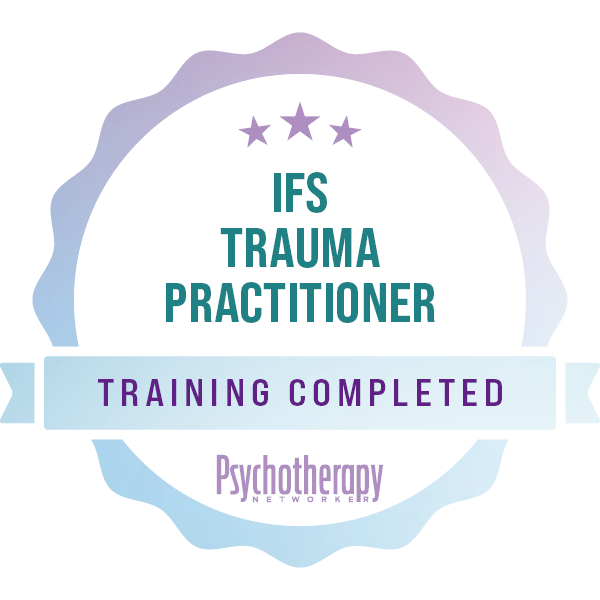
When you complete this training, you'll receive a Certificate of Completion and a digital badge — both documenting your advanced training in IFS-informed, phase-based trauma treatment, ready to display on your website, professional profiles, and marketing materials.
But for most therapists, the credential matters less than what it represents. This certificate signals that you've gone beyond basic continuing education — that you've invested in understanding how trauma is treated. Safely, ethically, and effectively.
with Daphne Fatter
$2,369.56 Value — Just $599.99 Today!
Click here for Credit hours breakdown | Click here for course objectives and outline
Trained at The Trauma Center under Bessel van der Kolk, MD • EMDR Certified + EMDRIA Approved Consultant • 20+ years in trauma treatment
Daphne Fatter, PhD, is a licensed psychologist, clinical consultant, author, and international speaker known for one thing: helping clinicians integrate powerful trauma modalities into a clear, safe, step-by-step method they can use with real clients.
She is the author of Integrating Internal Family Systems Interventions into EMDR Therapy and is widely recognized for her expertise in blending parts work with evidence-based trauma treatment.
Here's what makes her uniquely qualified to teach this training:
- EMDR Certified + EMDRIA Approved Consultant
- 20+ years providing trauma treatment
- Postdoctoral fellowship at The Trauma Center under the direct supervision of Bessel van der Kolk, MD
- Former Military Sexual Trauma Coordinator, Fort Worth VA Outpatient Clinic
- Certified ancestral healing practitioner; supports work with intergenerational and historical trauma
Published on IFS, EMDR, countertransference, mindfulness, and ancestral healing
Learn more at www.daphnefatterphd.com

No. Familiarity with trauma treatment is helpful, but the course builds the necessary foundation no matter your experience level. You don't need prior training in IFS, EMDR, or somatic approaches to benefit fully from this training.
Why Judith Herman's Trauma Recovery Model?
Herman's three-stage model — Safety, Remembrance and Mourning, Reconnection — has been the clinical gold standard for complex trauma treatment for more than 30 years. It's taught in graduate programs, embedded in major trauma modalities including EMDR, IFS, and Sensorimotor Psychotherapy, and referenced across global trauma-informed care systems — because it gets one thing fundamentally right: safety and stabilization must come before deep processing. Without that sequence, even the most powerful therapeutic tools risk retraumatization. That's why it's the framework this training is built around.
Is this appropriate if I have no IFS background?
Yes. The training is designed to meet you where you are. IFS concepts are taught from the ground up within the context of trauma treatment.
I'm already IFS-trained. Will this cover new ground?
Yes. This program goes beyond the IFS model and teaches you how to use it within a trauma-specific sequencing protocol. You get a session-by-session roadmap so you know exactly which phase your client is in, which parts to approach, and which interventions to hold until your client is ready. You'll also learn how to incorporate targeted cross-modal interventions into your approach so that you have a diverse range of tools to meet the unique needs of each client.
What's the difference between a certificate and certification?
This course awards a Certificate of Completion, documenting your completion of this clinical training. Certification programs are governed by external boards and typically require extensive supervision, evaluations, and ongoing oversight. This course does not include those elements — but the certificate reflects completion of rigorous, integrative training and signals a deeper level of professional development in trauma-informed practice.
with Daphne Fatter
$2,369.56 Value — Just $599.99 Today!
Click here for Credit hours breakdown | Click here for course objectives and outline
We’re that confident you'll find this learning experience to be all that's promised and more than you expected.