If your practice includes clients with diverse types of trauma and relationship challenges, this course will provide you with exceptional interventions to promote healing and growth. You'll get more than 20 interventions based on somatic therapy to work directly with trauma bonds, and you'll get dozens of techniques and interventions to support attachment rupture repair. Whether you're new to this type of work or you've been working with trauma for years, this specialized training can take your practice to the next level and help attract exactly the types of clients you want to work with most.
Healing Trauma Bonds Certificate: Clinical Tools to Break Toxic Cycles, Repair Insecure Attachment & Rebuild Self-Trust

When clients are wired for survival, be the clinician that brings the reset.
Trauma bonds don't just trap clients in destructive relationships — they wire survival, longing, fear, and attachment together in the brain.
The result is a powerful psychological loop that keeps clients returning to what hurts them.
…and keeps you treating the fallout instead of reaching the source.
This training gives you the clinical tools to understand these bonds at their roots — and to help clients finally break free.
Join Dr. Laura Copley and Dr. Robert Muller, two leaders in trauma bonds and attachment science, respectively, to get the tools that quiet the survival response so clients can build connection and heal.
Through a blend of neuroscience, attachment theory, somatic therapy, and a trauma-informed lens, you'll discover how to:
- Identify the explicit and implicit drivers that keep clients stuck in painful relational cycles
- Work with the nervous system to interrupt trauma bond activation in real time
- Unpair fear, shame, and longing in the brain's memory networks
- Restore internal safety, agency, and self-trust
- Support clients in forming healthy, secure relationships moving forward
Whether you're working with domestic violence, betrayal trauma, childhood attachment wounds, or coercive control, you'll walk away with a grounded, compassionate, and science-based framework for helping clients step out of survival mode and reclaim their freedom.
Designed to transform both your work and your clients' outcomes, this certificate course helps you meet the most challenging clinical moments with clarity, confidence, and skill.
Enroll now!
Healing Trauma Bonds Certificate
Clinical Tools to Break Toxic Cycles, Repair Insecure Attachment & Rebuild Self-Trust
$629.97 Value — Just $199.99 Today!
Plus, earn up to 15.25 CE Hours included in the course tuition.
Click here for Credit details | Click here for course objectives and outline
Click here for Credit details | Click here for course objectives and outline
Healing Trauma Bonds Certificate Outline
Get more than 20 interventions for repairing the damage from trauma bonded clients. Then, gain specialized skills for working with attachment wounds and repairing internal safety.
Breaking Trauma Bonds: 20 Clinical Interventions and Somatic Exercises to End Toxic Cycles & Rebuild Self-Trust
Dr. Laura Copley
Join Dr. Laura Copley, acclaimed expert in relationship trauma, specializing in trauma bonds and post-traumatic growth, for a ground-breaking workshop. Dr. Copley's celebrated book Loving You is Hurting Me has helped clinicians and clients alike find new meaning after toxic relationships. Now, you're getting the key interventions and somatic exercises directly from Dr. Copley.
The Trauma Bonded Client- What are we missing with this population?
- Do more effective work with trauma-bonded clients
- Explore Dr. Copley’s research and trauma-informed approaches
- at is needed to do better work with trauma bonded individuals?
- INTERVENTIONS: “Not My Best Moment” visualization exercise and “Self-Forgiveness” practice
- Trauma-informed considerations before beginning therapy
- What is titrating and how to do it?
- Applied Relational Neuroscience and Positive Psychology
- Teaching clients “The Art of Discernment”
- INTERVENIONS: Polyvagal-inspired “Meet Your Nervous System” and “What Grounds Me?” exercise, Havening Techniques for safety, Parts Mapping for “Creating Inner Guardians” and client’s “Gathering Place” Activities, Intro to Bilateral Stimulation
- How the 5 major attachment traumas are linked to worthiness
- Know how attachment traumas play out as current reactions and behaviors
- Examine and undo the impact of family-of-origin roles and attachment wounds
- Reparent the inner child and its wounds
- INTERVENTIONS: “Meeting Your Wounded Inner Child” Parts Work activity and worksheet, “Little Me Reconnection” photograph exercise, and Establishing Unmet Needs, “Dialoguing with Inner Guardians” as a Reparenting writing exercise
- Identifying Protectors, Blocks, and Resistance, and a new mindsight on how to perceive them
- Sensitively overcome client resistance and prepare them for healthy self-disclosures
- Explore the continuum of trauma bonding, red flags and narcissism
- Paradigm shift away from “victim-perpetrator” mindset
- Signs of abuse
- Know the 7 stages of trauma bonding
- INTERVENTIONS: “Signed, Sealed, Delivered” resistance activity, Emotion-Focused Therapy for Couples and “The Dance”, “Mapping Out the Toxic Hook” and Somatic Therapy, The Psychology of Ritual “Chord Cutting”, Somatic Experiencing Exercise, “Creating Your Self-Trust Mantra”, clinical movie analysis
- Your role as a guide to corrective emotional experiences
- Gottman’s research on Stages of Repair
- Help clients identify their unmet needs and “toxic hook” cycle
- Explore new narratives with writing exercises from Narrative Exposure Therapy
- How to get clients speaking to their “Embodied Self”
- Apply Brene Brown’s work on vulnerability & Ester Perel’s research on intimacy and connection
- Therapeutic questionnaire for clients’ self-exploration
- INTERVENTIONS: Qi Gong Activity for Healing Energy, Tapping-in (installing) a new narrative (“Even though I feel… I know I am…”), Narrative Exposure Therapy using storytelling and letter-writing,“Know Thyself, Trust Thyself” Exercise and how to speak on behalf of parts, “Getting to Know You,.. Again” re-connection questionnaire
- The key to authentic connections after trauma bonding
- How PTG looks after toxic relationships
- Incorporate the “hero’s journey” into healing
- The 5 key experiences in PTG
- Create interpersonal transformation and growth after therapy ends
- INTERVENTIONS: “Benefit Finding” exercise for Individuals and Couples, “Playlist for Parts” coming to aid an unmet need, Two-Chair Technique from Healed Self to Trauma Wounds, Trauma Transformation Timeline Exercise, and Re-authoring the story
- When treatment doesn’t work
- The role of personality disorders in treatment
- Address and identify misunderstandings
- Emergence of new symptoms and triggers
- Unmet expectations, drama and disappointment
- Contraindications and Cultural Considerations:
- Newness and evidence for the presented content


Attachment-Centered Therapy for Healing Ruptures and Restoring Bonds
Dr. Robert Muller
Join Dr. Robert Muller, author of psychotherapy bestseller, Trauma and the Avoidant Client: Attachment Based Strategies for Healing, to learn specific, evidence-based techniques using a relational, integrative approach that emphasizes your own healing and countertransference as a therapist.
Opening Up About Trauma: A Relational Process
- When trauma teaches silence: “You mustn’t tell anyone!”
- How trauma stories “leak out” in therapy—even when clients resist opening up
- Avoidance in trauma work: Why clients sidestep painful feelings and relationships
- Mutual avoidance: When both therapist and client unconsciously steer away from trauma—“This feels too overwhelming!”
- Risks and limitations of the research
- Recognizing when a client rushes into trauma work—and why it can backfire
- Techniques to slow down and create a sense of safety before diving deeper
- When the therapist moves too fast: Understanding the impulse to push forward
- How rushing—on either side—can destabilize the process and undermine progress
- Understanding how your own attachment history shapes clinical interactions
- Countertransference patterns in trauma therapy—and how they show up in session
- The rescue fantasy: The urge to “fix” or save the client
- Feeling bullied by the client: Power struggles and therapist reactivity
- Compassion fatigue and disengagement: When hopelessness sets in
- Using self-awareness to strengthen therapeutic connection and resilience
- How enactments—unconscious relational patterns—create ruptures in therapy
- Spotting when the therapeutic relationship is going off track
- The rupture-repair process:
- Looking inside: The therapist’s role in relational breakdowns
- Validating: Acknowledging the client’s experience without defensiveness
- Providing containment: Rebuilding safety and trust
- Mentalizing: Helping clients reflect on their own emotional responses
- Turning conflict into growth: Using relational challenges to deepen the alliance
BONUS! $129.99 Value, COMPLETELY FREE CE Training!
Healing Trauma from Narcissistic Abuse Using a DBT Approach
Katelyn Baxter-Musser
Learn how to incorporate the four pillars of DBT into the unique challenges posed by narcissistic abuse. This innovative approach provides concrete strategies for clients to manage overwhelming emotions and triggers, learn to trust oneself in relationships, set healthy boundaries, and cultivate a deeper sense of self-compassion. Discover…
Understanding Narcissistic Abuse Trauma
- The impact of narcissistic abuse on survivors
- Common manifestations of trauma in clients affected by narcissistic abuse
- Unique challenges faced by survivors in rebuilding their lives
Essentials of Dialectical Behavior Therapy (DBT) for Trauma
- Overview principles and techniques relevant to trauma recovery
- Role in addressing emotional dysregulation and distress tolerance
- Combine with traditional therapeutic approaches in healing trauma from narcissistic abuse
- Research and limitations
DBT Skills for Emotional Regulation, Resilience, and Self-Compassion
- Skills for emotional regulation, including mindfulness and distress tolerance
- Techniques for managing overwhelming emotions triggered by narcissistic abuse
- Importance of self-compassion as a cornerstone of healing and resilience
Rebuilding Lives: Implement DBT in Clinical Practice
- DBT techniques into trauma-informed therapy for survivors of narcissistic abuse
- Tailor interventions to meet the unique needs of individual clients
- Actionable strategies to support clients in their journey of healing
- Self-compassion as a central element in the recovery process
Downloadable Digital Badge & Printable Certificate of Completion
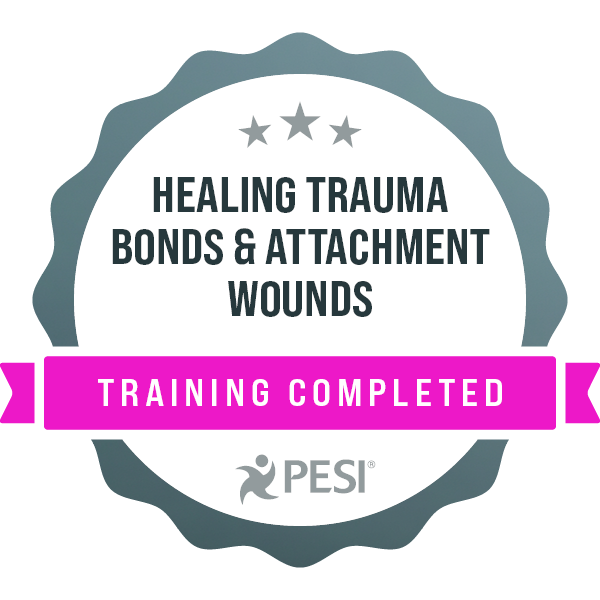
Downloadable Digital Badge
Share it on ALL your therapist, coach, and clinical profiles!

Printable Certificate of Completion
Display it on your office wall to admire.
Healing Trauma Bonds Certificate
Clinical Tools to Break Toxic Cycles, Repair Insecure Attachment & Rebuild Self-Trust
$629.97 Value — Just $199.99 Today!
Plus, earn up to 15.25 CE Hours included in the course tuition.
Click here for Credit details | Click here for course objectives and outline
Click here for Credit details | Click here for course objectives and outline
Meet Your Speakers

Dr. Laura Copley, LPC
Dr. Laura Copley, LPC, is an acclaimed expert in the field of relationship trauma, specializing in trauma bonds, toxic relationships, and post-traumatic growth. Her groundbreaking work emphasizes self-trust as the “secret sauce” to breaking toxic patterns and healing trauma bonds, providing clients and readers with the tools to rebuild their lives and relationships from the inside out.

Dr. Robert Muller
Dr. Robert Muller, is a Harvard-educated psychologist specializing in attachment trauma and repair. His most recent psychotherapy book, Trauma & the Struggle to Open Up: From Avoidance to Recovery and Growth, was awarded the 2019 Written Media Award for the year's best written work on trauma. His award-winning bestseller, Trauma & the Avoidant Client: Attachment-Based Strategies for Healing, has been translated widely. Dr. Muller presents internationally on his research, books, and more.

Katelyn Baxter-Musser, LCSW, C-DBT
Katelyn Baxter-Musser, LCSW, C-DBT, is certified in DBT and EMDR and has achieved notoriety in the therapeutic work related to domestic violence, abuse, trauma, PTSD, depression, anxiety, grief, personality disorders, and relationship issues. Her clinical experience includes working for ten years in various roles as a case manager, child and family therapist, and trauma therapist for several agencies and Native American reservations.
Frequently Asked Questions
A certificate is a document issued upon the completion of a training program. It signifies that you have trained on specific skills, have trained with a particular individual, or have acquired knowledge in a particular subject.
Certification, on the other hand, often requires you to meet specific standards, pass rigorous exams, and many even include additional practice, consultation, supervision, evaluations, and ongoing continuing education requirements. While you will need to pass an exam, this course does not include many of these elements — making this a "certificate" program.
This certificate does distinguish you as a professional who has trained more extensively in the area of trauma bonds and attachment wounds… and it's an acknowledgment that can set you apart in the eyes of clients and peers.
You'll have access to all modules immediately, including the bonus training, all slides, resources, and more!
Healing Trauma Bonds Certificate
Clinical Tools to Break Toxic Cycles, Repair Insecure Attachment & Rebuild Self-Trust
$629.97 Value — Just $199.99 Today!
Plus, earn up to 15.25 CE Hours included in the course tuition.
Click here for Credit details | Click here for course objectives and outline
Click here for Credit details | Click here for course objectives and outline
100% Satisfaction Guarantee
Register for this intensive training course without risk. If you're not completely satisfied, give us a call at 800-844-8260.We’re that confident you'll find this learning experience to be all that's promised and more than you expected.