

Please wait ...

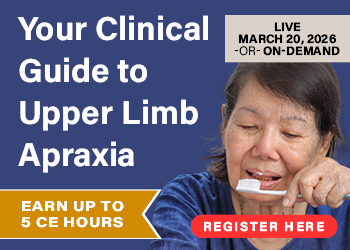
You’ve seen them before. Patients who should be able to brush their teeth, use a spoon, or get dressed.

But something’s just not clicking. It’s not weakness. It’s not confusion. It’s not memory loss.

It’s apraxia. And it’s more common — and more overlooked — than you think.

If you can’t differentiate it from more common conditions like stroke, dementia, ataxia, or brain injury…

…apraxia will continue to disrupt your patients’ motor planning, tool use, sequencing, executive functioning and coordination — which makes it hard for them to get dressed, groom themselves, cook, or perform basic self-care.

Good news: You can build the clinical skills you need to elevate your clinical reasoning, unlock recovery where others see roadblocks, and confidently treat any type of apraxia.

In just a single day, you’ll learn to:

  • Confidently recognize when apraxia is disrupting your patient’s function, and know exactly what to do about!
  • Break down the cognitive-motor disconnect limiting your patient’s potential and turn it into an action plan for recovery
  • Customize evidence-informed interventions to rebuild purposeful movement your patient is desperate to get back
  • Move beyond basic neuro approaches with strategies to address the core connection between intention and execution

You’re not just restoring movement — you’re restoring agency. Enroll today!


LIVE VIRTUAL EVENT

Your Clinical Guide to Upper Limb Apraxia:
Identification, Differential Diagnosis & Evidence-Based Treatment Strategies

March 20, 2026 • 9:00 AM - 3:30 PM CT

$129.99 (Valued at $249.99)

Join Virtually
9:00 AM - 3:30 PM CT
• Opportunity for Q&A with speaker
• Online access available for 90 days afterwards
Can't Attend Live?
Learn On Demand
• Watch on your own schedule
• Unlimited Access
Earn up to 5 CE Hours! Click here for Credit details
Join Today, and Here Is What You’ll Get…

  • Tailored functional interventions to considerably improve deficits in motor praxis and eliminate - sequencing faults, conceptual errors, lack of spatial motor control, compromised tools utilization, and more!
  • Discover new evaluation approaches to objectively measure and document progress such as the Diagnostic Instrument for Limb Apraxia (DILA-S), Florida Apraxia Battery-Extended and revised Sydney (FABERS), Barthel Index, and more!
  • Interactive activities to enhance fine motor skills, coordination, motor planning, and task execution.
  • Strategies to improve treatment planning and the holistic treatment of individuals with deficits in praxis.


Training Outline

Foundations of Limb Kinetics in Apraxia
  • Limb kinetic principles
  • Overview of apraxia types: ideational, ideomotor, and conceptual
  • Functional impact of apraxia on daily activities and occupation

Identification and Assessment Techniques
  • Standardized assessments and observational methods
  • Clinical cues for each apraxia type
  • Case study reviews for practical application
  • Practice assessments through simulated cases

Differential Diagnosis and Clinical Reasoning
  • Key diagnostic indicators and differential features
  • Common misdiagnoses and how to avoid them
  • Analysis of apraxic presentations for pattern recognition

Treatment Planning and Intervention Strategies
  • Intervention frameworks and treatment hierarchy
  • Task-oriented approaches and compensatory strategies
  • Adapting treatment for functional and cognitive outcomes
  • Designing sample plan of care

Case Application and Advanced Clinical Techniques
  • Complex cases with multiple apraxia presentations
  • Problem-solving for unique challenges in therapy
  • Advanced techniques for treatment adaptation
  • Interactive case studies and peer feedback

Training Summary and Q&A
  • Recap of key concepts and learned skills
  • Open discussion on applying skills into clinical practice
  • Q&A session for participant-specific challenges or patient-scenarios


Objectives

  1. Identify key characteristics and presentations of ideational, ideomotor, and conceptual apraxia.
  2. Differentiate between each type of apraxia in the clinical assessment.
  3. Examine how types of apraxia impede occupation, daily activities, and community independence.
  4. Choose evidence-based interventions tailored to specific apraxia presentations.
  5. Evaluate treatment planning and adapt therapeutic interventions for diverse client population.

LIVE VIRTUAL EVENT

Your Clinical Guide to Upper Limb Apraxia:
Identification, Differential Diagnosis & Evidence-Based Treatment Strategies

March 20, 2026 • 9:00 AM - 3:30 PM CT

$129.99 (Valued at $249.99)

Join Virtually
9:00 AM - 3:30 PM CT
• Opportunity for Q&A with speaker
• Online access available for 90 days afterwards
Can't Attend Live?
Learn On Demand
• Watch on your own schedule
• Unlimited Access
Earn up to 5 CE Hours! Click here for Credit details
Meet Your Upper Limb Kinetics Expert


Kristin Valdes, OTD, OT, CHT
Kristin Valdes, OTD, OT, CHT, is an expert in upper extremity rehabilitation, with over 30 years of experience in private practice helping patients recover lost function and return to the activities they value. A past president of the American Society of Hand Therapists, her clinical expertise spans treatment of the hand, wrist, elbow, and shoulder.

Dr. Valdes travels nationally to present seminars on upper extremity rehabilitation and is known for her engaging, hands-on teaching style. She earned her doctorate in occupational therapy with a specialization in hand rehabilitation from Rocky Mountain University of Health Care Professions in Provo, UT, and she works as a professor at Touro University in Nevada.

Click here for information about Kristin Valdes

Frequently Asked Questions

Who is this training designed for?

  • Occupational Therapists
  • Occupational Therapist Assistants
  • Physical Therapists
  • Physical Therapist Assistants

What will the schedule look like?

There will be a 60-minute lunch and two 15-minute breaks; one in the morning and one in the afternoon. Lunch and break times will be announced by the speaker and at their discretion. A more detailed schedule is available upon request.


Is this really a live training? Can I ask questions?

YES! The training is LIVE and you'll be able to ask questions directly to Kristin Valdes, OTD, OT, CHT! Though she may not get to all of them, she will try to answer the most relevant and frequent ones.


100% Satisfaction Guarantee
Register for this intensive training course without risk. If you're not completely satisfied, give us a call at 800-844-8260.

We’re that confident you'll find this learning experience to be all that's promised and more than you expected.

For live CE credit, you must watch the live webcast in its entirety at its scheduled time and complete the CE quiz and evaluation within one week.
You will have access for 90 days after the program for review.


NOTE: No additional discounts or coupons may be applied to this event.
PWZ94996 • © PESI Inc. • All rights reserved • Email: customersupport@pesi.com • Phone: 800-844-8260 • FAQ: www.pesi.com/faq
Back to Top