- Utilize clinical assessments to diagnose trauma based on traumatic events.
- Evaluate indicators of unprocessed traumatic memories.
- Integrate the Three Phase Model in trauma treatment plans.
- Examine existing research on the efficacy of EMDR in trauma treatment.
- Identify three contraindications for using EMDR therapy.
- Evaluate the role of maladaptively stored memories in the AIP model and how they impact trauma processing.
- Identify the standardized EMDR protocol and its components.
- Choose EMDR resource techniques to support trauma processing.
- Determine the role of bilateral stimulation in memory processing.
- Use eye movement techniques from EDMR to influence the vividness of distressing memories in clients.
- Utilize visual, auditory and tactile bilateral stimulation (BLS) techniques in EMDR therapy to facilitate the reprocessing of traumatic memories.
- Evaluate when and how EMDR can be integrated into treatment for clients with complex trauma based on severity, symptom presentation, and individual needs.
- Identify best practices for treating clients with EMDR therapy via telehealth.
- Identify signs of emotional overwhelm or distress during EDMR sessions.
- Analyze the principles of Attachment-Focused EMDR and its use in the treatment of childhood and adult trauma.
- Examine the benefits and limitations of integrating EMDR with other therapeutic approaches and methods.
- Examine how parts work language and concepts can be utilized to facilitate the processing of traumatic memories in EDMR therapy.
- Integrate somatic techniques into EMDR to regulate physiological responses involved in trauma.
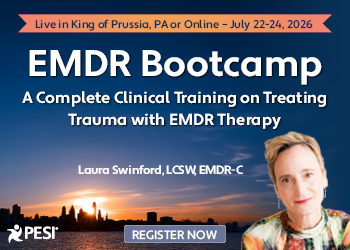
PA 3-Day EMDR Bootcamp: A Complete Clinical Training on Treating Trauma with EMDR Therapy

Introducing the EMDR Bootcamp – A live training experience designed to transform you into an EMDR therapist.
You’ll join Laura Swinford, a certified EMDR clinician, approved consultant and EMDR instructor whose trainings have helped hundreds of clinicians just like you bring EMDR into their practices.
Laura will guide you step by step, breaking down each key element of the EMDR process ensuring you leave the bootcamp with a complete understanding of how to treat trauma using EMDR therapy.
The Results You Can Expect:
- Master the 8-Phase EMDR Protocol: Learn how to guide clients through each phase of the EMDR process, from assessment to reprocessing and installation of positive cognitions.
- Develop real-world EMDR Skills: Use bilateral stimulation (BLS), cognitive interweaves, and other EMDR techniques in person or in online sessions.
- Strategies for working with complex trauma and dissociation: Tailor EMDR for individuals with challenging trauma histories.
- Tools to navigate problems: Handle client resistance, blocks, or difficulties that may arise during the EMDR process.
- And much more!
Unlike other courses that rely on pre-recorded videos, you’ll experience live, interactive sessions with an experienced EMDR trainer so you can ask questions and engage in exercises that make the material stick.
EMDR therapy is one of the most respected and trusted trauma treatments available today.
Don’t miss this chance to learn exactly how to use it in just 3 days.
Register now and reserve your spot in the EMDR Bootcamp today!
3-Day EMDR Bootcamp:
A Complete Clinical Training on Treating Trauma with EMDR Therapy
A Complete Clinical Training on Treating Trauma with EMDR Therapy
July 22-24, 2026 from 8:00am-4:00pm ET
Join Live in King of Prussia, PA
The Alloy, King of Prussia
Limited Seats Available
Limited Seats Available
8:00 AM - 4:00 PM ET
Earn up to 19 CE Hours
Archive Recording Available for 90 Days
$599.99
Virtual Webcast
Join live from anywhere
8:00 AM - 4:00 PM ET
Earn up to 19 CE Hours
Archive Recording Available for 90 Days
$599.99
What You’ll Learn:
Day 1
- Trauma and Complex Trauma Treatment Review
- Neurobiology of Trauma and Symptomology
- EMDR Overview: Research, Treatment Risks, and Limitations
- Determine Appropriateness for EMDR
- Start EMDR Safely
- Screening Instruments and Assessment
- Clinical Implications of Using Dual Awareness and Methods of Bilateral Stimulation
- The AIP Model: How EMDR Incorporates Adaptive Information Processing
Day 2
- Phase 1: History Taking, Case Conceptualization, and Treatment Planning
- Phase 2: Preparation and Resourcing
- Peaceful Place
- Container
- Internal Resource Team
- Light Stream
- Breathing Exercises
- Somatic Resourcing
- Mechanics and Set Up for BLS
- Phase 3: Assessment and Target Set-Up
- Identify the Target
- Floatbacks
- Negative and Positive Cognition
Day 3
- Phase 4: Desensitization & Trauma Processing
- Beginning the Processing Phase
- Giving Feedback After Each Set of BLS
- When to return to Targets
- Taking a SUD
- Titrating the Target and Graduating the Work
- Feeder Memories and Stuck Processing
- Work with Blocking Beliefs
- Desensitization and Processing
- If the Client Wants to Stop or Pause
- Phase 5: Installation of Positive Cognition
- Phase 6: Body Scan
- Phase 7: Closure
- Instructions for Closing all Sessions
- Instructions for Completed Targets
- Phase 8: Re-Evaluation
- EMDR Issues, Additions, and Adaptations
- Working with Blocking and Looping
- Restricting the Standard Protocol
- Cognitive Interweaves
- Working with Parts
- Working with Attachment Wounding
EMDR is a skill you perform — not a theory you memorize Watch - See it done in real time Practice - Run it yourself, with support Ask - Bring your hardest questions Refine - Get corrected before it sticks Across the three days, you’ll rotate through three roles in small group practice — observer, client, and therapist. Sitting in each seat is how the protocol stops being something you’ve read about and becomes something you can do. Why Live Changes Everything
You already know EMDR works. The real question is how you actually learn to do it well. A pre-recorded course can explain the protocol. It can’t catch the moment your pacing slips, your target is too broad, or your client starts to flood — and correct it before it becomes a habit. That only happens live.
Watch full EMDR sequences demonstrated live — including the small in-the-moment decisions that never make it into a manual.
Practice the phases hands-on in guided small groups — not alone, weeks later, hoping you remembered it right.
Ask the messy clinical questions — blocking beliefs, dissociation, looping — and get answers from an experienced consultant during live Q&A.
Receive immediate feedback as you go, so you build accurate technique and real confidence from day one.
Real Testimonials. Real Therapists.
 “I have been wanting to get EMDR trained for a long time. This was AWESOME! Exceeded my lofty expectations.”
—Marvin G, Social Worker
“This course was truly incredible, and especially thanks to our instructor.”
—Briane H, Counselor
“All around fantastic. A great learning experience.”
—Jill P, Social Worker
Reserve your room now!
The Alloy
“I have been wanting to get EMDR trained for a long time. This was AWESOME! Exceeded my lofty expectations.”
—Marvin G, Social Worker
“This course was truly incredible, and especially thanks to our instructor.”
—Briane H, Counselor
“All around fantastic. A great learning experience.”
—Jill P, Social Worker
Reserve your room now!
The Alloy
301 W. Dekalb Pike
King of Prussia, PA 19406
610-337-1200
Join us at the Alloy, a Doubletree by Hilton in King of Prussia, PA—just steps from the King of Prussia Mall, one of the largest shopping destinations on the East Coast. When you're not earning CE credits, explore Valley Forge National Historical Park, enjoy world-class dining, or take a short drive to Philadelphia's iconic attractions. It's the perfect blend of professional development and personal getaway.
Rooms start at $159/night. Don’t delay! Our special room rates expire June 30, 2026, or until the room block is full. Space is limited and the hotel will book quickly.


3-Day EMDR Bootcamp:
A Complete Clinical Training on Treating Trauma with EMDR Therapy
A Complete Clinical Training on Treating Trauma with EMDR Therapy
July 22-24, 2026 from 8:00am-4:00pm ET
Join Live in King of Prussia, PA
The Alloy, King of Prussia
Limited Seats Available
Limited Seats Available
8:00 AM - 4:00 PM ET
Earn up to 19 CE Hours
Archive Recording Available for 90 Days
$599.99
Virtual Webcast
Join live from anywhere
8:00 AM - 4:00 PM ET
Earn up to 19 CE Hours
Archive Recording Available for 90 Days
$599.99
An invitation from your presenter:
You've seen it happen: A client finally understands why they keep choosing the wrong partner, why they can't relax, why their body won't let them feel safe—and yet nothing changes.
Insight isn't enough. Because trauma doesn't live in the thinking brain. It's frozen in the body, timestamped in fragments of sensation, image, and emotion that keep replaying like it's happening right now.
That's where EMDR comes in—and it's why this training exists.
Over three days, I'm going to show you exactly how to help clients process trauma in a way that actually reorganizes their nervous system. Not just talk about it. Actually shift it.
You'll learn the 8-phase protocol that's helped my clients—and hundreds of therapists I've trained—finally reach those stuck places where traditional therapy couldn't go. We'll practice together in real time so you leave with skills you can use immediately.
This isn't about memorizing theory or watching pre-recorded videos. It's experiential, live, and grounded in what actually works when you're sitting across from someone whose system is screaming "danger" when there is none.
We'll take care of our nervous systems together as we learn. We'll breathe, practice, and build community. And by the end, you'll know how to guide your clients back to their own capacity for healing.
I hope you'll join me.
Laura Swinford, LCSW, EMDR-C
Meet Your Expert

Laura Swinford, LCSW, EMDR-C
Laura Swinford, LCSW, EMDR-C, is certified in EMDR, trains therapists as part of PESI’s 6-month EMDR Certification Program and provides EMDR consultation. She works as a therapist in a group private practice specializing in the treatment of trauma using EMDR, Ego State Therapy and Somatic Experiencing®. She has been certified in EMDR for nearly a decade and has used it with clients over that span to help them better process their past traumas and increase their ability to identify and cope with destructive emotions. She has more than 15 years of clinical experience and is also a published author of research work in the mental health field. Ms. Swinford previously served as an adjunct professor at University of Illinois Champaign-Urbana, where she taught evidence-based treatment to master’s level students. Ms. Swinford believes in connection and relationship as she journeys through life. She brings this approach to her work, matching techniques to the needs of her clients.
Your Peers Are Raving About Training With Laura

"Laura did a great job! Her knowledge of EMDR was amazing."
–Kayla M, Social Worker
"Laura is an amazing presenter! She covered a wealth of material in a short period of time, but took the time to address needs of participants. Laura knows the material and presents it in a meaningful way that can be put into practice. I highly recommend this course!"
–Julie F, Counselor
"I am very satisfied, I feel as if I walk away from this with a wealth of knowledge. Laura was so welcoming and supportive throughout. It was clear that she knew the material well but also that she genuinely cared for us as participants and ensured we got what we needed from the course."
–Gabriella V, Counselor
3-Day EMDR Bootcamp:
A Complete Clinical Training on Treating Trauma with EMDR Therapy
A Complete Clinical Training on Treating Trauma with EMDR Therapy
July 22-24, 2026 from 8:00am-4:00pm ET
Join Live in King of Prussia, PA
The Alloy, King of Prussia
Limited Seats Available
Limited Seats Available
8:00 AM - 4:00 PM ET
Earn up to 19 CE Hours
Archive Recording Available for 90 Days
$599.99
Virtual Webcast
Join live from anywhere
8:00 AM - 4:00 PM ET
Earn up to 19 CE Hours
Archive Recording Available for 90 Days
$599.99
Frequently Asked Questions
I've never used EMDR before. Will I actually be able to use it with clients after just 3 days?
Yes! This bootcamp is designed specifically to get you practicing, not just learning theory. You'll work through each of the 8 phases with hands-on exercises, scripts you can use immediately, and live feedback from Laura. Past participants have walked away feeling confident enough to start incorporating EMDR techniques—like peaceful place, containment, and bilateral stimulation—into their very next sessions.
What makes this different from other EMDR trainings out there?
Two things: it's live, and it's Laura. You're not watching pre-recorded videos and hoping you understood correctly—you're in the room (virtually or in Nashville) with an experienced EMDR consultant who answers your questions in real time. And if you want to go further, this training can serve as your launchpad into full EMDR certification through an additional 6-month consultation track.
What will the schedule look like?
July 22-24, 2026 from 8:00-4:00pm ET
There will be a 70-minute lunch and two 15-minute breaks; one in the morning and one in the afternoon. Lunch and break times will be announced by the speaker and at their discretion. A more detailed schedule is available upon request.
Please note: You will have access for 90 days after the program for review. For live CE credit, you must watch the live presentation in its entirety at its scheduled time and complete the CE quiz and evaluation within one week. Please note that this requirement may vary by credit type. Please see detailed credit information for specific requirements for each credit type.
Who is this training designed for?
This training is designed for:
- Counselors
- Social Workers
- Marriage and Family Therapists
- Psychologists
- Addiction Counselors
- Nurse Practitioners
- Physicians
- Others in caring professions
What is the in-person cancellation policy?
From Purchase Date until June 22, 2026: Cancellation results in a full refund less a $100 administrative fee
From June 23, 2026: Cancellation results in a 50% penalty of the total purchase amount
Event Countdown
0
Days
:
0
Hours
:
0
Minutes
:
0
Seconds