Please wait ...

Your Clients Aren't Too Fragile. We Just Blamed Them Instead of the Therapy.

When patients struggled with traditional exposure-based approaches, we didn't question the treatment. We created language around "client readiness" and "fragility." We decided they weren't ready for trauma work.

But what if the problem was never the client?

Cognitive Processing Therapy takes a different approach—one that gives clients choice about whether to talk about what happened. One that works across every trauma type, in 45 countries, with the "complex" cases everyone else said weren't ready.

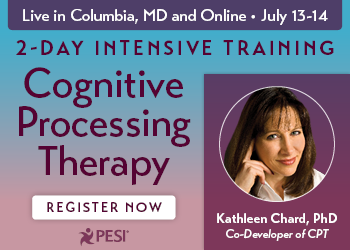
Dr. Kathleen Chard co-created CPT over 30 years ago and has since trained over 5,000 clinicians personally—plus tens of thousands more as VA CPT Implementation Director. She's tested this approach with veterans, civilians, sexual abuse survivors, patients with TBI, substance use, personality disorders, and suicidal ideation. The clients everyone else said "weren't ready."

Endorsed by the U.S. Departments of Veterans Affairs and Defense, the International Society of Traumatic Stress Studies, and the U.K. National Institute for Health and Care Excellence (NICE) as a best practice for the treatment of PTSD, Cognitive Processing Therapy (CPT) is an evidence-based approach to treating trauma that helps clients:

  • Understand why recovery from traumatic events is difficult and how symptoms affect daily life
  • Reduce distress related to memories of the trauma
  • Decrease emotional numbing and avoidance of trauma reminders
  • Improve day-to-day living by decreasing depression, anxiety, guilt or shame

In this 2-day intensive training, you'll learn CPT directly from its co-creator. Dr. Chard will walk you through every step of this highly structured, 12-session cognitive treatment approach from start to finish—designed to prepare you to use CPT with your clients right away.

Limited slots available and they will fill fast. Register now!

Get Everything You Need to Use CPT in 2 Days. Use It For 20 Years.

July 13-14, 2026 • 8:00 AM - 4:00 PM ET

Live in Columbia, MD
Limited seats available – secure yours now

★ Two days LIVE training with Dr. Kathleen Chard
★ Breakfast and Lunch Included!
★ Up to 12.5 CE Hours
★ Hands on learning and personalized interactions
★ Network with your peers from across the country


$799.99 $599.99
Can’t Attend In-Person?
Join Us Live Online

★ Two days LIVE ONLINE training with Dr. Kathleen Chard
★ Join us from the comfort of your home
★ Up to 12.5 CE Hours
★ LIVE online Q&A
★ Virtual networking with colleagues across the country


$399.99 $199.99

What You'll Get

  • Session-by-session instructions, scripts, worksheets, and handouts to move your clients from suffering to healing
  • The who, when and how of CPT for your specific practice setting
  • Powerful cognitive restructuring skills to help clients overcome ways of thinking that keep them "stuck"
  • Effective ways to utilize structure and consistency so clients become their own CPT therapist
  • Techniques to help clients release themselves from shame, guilt and blame about the trauma
  • Opportunities to practice, ask questions, and receive feedback from Dr. Chard herself
  • The CPT manual (a $55 value) included with your registration

Limited slots are available and they fill fast. Register now!

A Personal Invitation from Dr. Kathleen Chard


Hi, I'm Kate Chard, and I need to be honest with you about something.

For the first 15 years of my career, I made people talk about their trauma. I'd make them cry. I'd make them tell it again. "Process your feelings," I'd say. Because that's what I was taught. That's what we all were taught.

But here's what I've learned after 30 years of doing this work: We blamed the client instead of blaming the therapy.

When patients struggled with exposure-based approaches, we didn't question the treatment. Instead, we created an entire language around "readiness" and "fragility." We decided our clients weren't ready—too complex, too dysregulated, too fragile to handle trauma work.

So we parked them in readiness groups and coping skills training. And now the research is clear: those approaches make patients worse. They're associated with the second-highest suicide rate in the VA system, while evidence-based treatment programs have the lowest rates.

I've run trauma clinics for 25 years. Not a single suicide. And that's not because I'm special—it's because evidence-based treatments work.

This is why CPT is different.

Your clients don't have to talk about what happened. They choose whether to use a written narrative or not. Instead of forcing them to relive the trauma, we work with what it means to them—the stuck points that keep them from recovering. We give them back their choice, their control, their voice.

And before you think, "But what about my complex clients?"—let me stop you there. CPT works across every trauma type we've tested, in 16 languages, across 45 countries. It works with veterans, civilians, sexual abuse survivors, people with substance use, personality disorders, suicidal ideation. The clients you think are "too fragile"? They're exactly who this is for.

Here's what I want to give you over these two days: The confidence I wish I'd had 30 years ago. The session-by-session roadmap that will let you walk back into your practice and actually help people heal—not just manage symptoms. The truth about what works, backed by solid research, not myths we've been carrying around for decades.

I'll show you videos. I'll answer your hardest questions. I'll address every barrier you're worried about—TBI, developmental delays, comorbidities, the clients you're convinced won't be able to do this work. We'll talk about how to make this fit in your real-world practice.

I'm not here to tell you CPT is the only answer. I'm trained in every evidence-based treatment for PTSD because I believe in finding the right fit for each person. But what I can tell you is this: CPT gives clients their power back. And after 25 years of watching people heal—people everyone else said weren't ready—I know it works.

So bring your skepticism. Bring your hard cases. Bring your questions.

When you leave, you'll have everything you need: the manual (free with registration), the worksheets, the scripts, the confidence. And most importantly, you'll be ready to look at that client who's been waiting—who's been told they're not ready—and say, "Let's do this. Let's help you get better."

Limited slots fill fast. I hope you'll join me.

Kathleen Chard, PhD
Co-developer of CPT
Director, Trauma Recovery Center, Cincinnati VA Medical Center

P.S. — Your clients are ready. The question is: are we ready to stop underestimating them?

Your Complex Cases? They're Exactly Who This Is For.

July 13-14, 2026 • 8:00 AM - 4:00 PM ET

Live in Columbia, MD
Limited seats available – secure yours now

★ Two days LIVE training with Dr. Kathleen Chard
★ Breakfast and Lunch Included!
★ Up to 12.5 CE Hours
★ Hands on learning and personalized interactions
★ Network with your peers from across the country


$799.99 $599.99
Can’t Attend In-Person?
Join Us Live Online

★ Two days LIVE ONLINE training with Dr. Kathleen Chard
★ Join us from the comfort of your home
★ Up to 12.5 CE Hours
★ LIVE online Q&A
★ Virtual networking with colleagues across the country


$399.99 $199.99

What Therapists Are Saying About Training with Dr. Chard
Program Schedule – July 13-14, 2026
8am-4pm Eastern Time


WHAT IS COGNITIVE PROCESSING THERAPY (CPT)?
  • The evolution of the approach – and why that matters today
  • CPT and CPT+A
  • Empirical evidence supporting CPT
  • Limitations of the research and potential risks
  • Structure: Review, content, check in, assignment

TREATMENT CONSIDERATIONS: SETTING THE STAGE CLINICALLY
  • The who, when and how of CPT
  • How to gather trauma history to identify the index event
  • Assessment: PCL-5 and PHQ-9, co-morbidities and risk of harm
  • Family involvement considerations
  • Discerning between assimilated and overaccommodated beliefs
  • Balancing structure with ongoing case conceptualization and flexibility

ARE YOU READY TO DELIVER CPT?
  • Core competencies of the CPT therapist
  • Common areas of therapist uncertainty: client readiness, using a manualized approach and more
  • CPT errors most clinicians make (and what to do about them)

SESSION 1: OVERVIEW OF PTSD AND CPT
  • Explaining PTSD symptom clusters (and how they interact) in an understandable way
  • PTSD as a problem of non-recovery; why people get “stuck”
  • Cognitive theory within the context of trauma
  • How CPT will help clients move forward
  • “Stuck Points” and the Impact Statement

SESSIONS 2 & 3: CONNECTING EVENTS, THOUGHTS AND FEELINGS
  • What are “Stuck Points” and how do I identify them?
  • Introduction of trauma-related ABC model
  • Identification and labeling of emotions (accurately)
  • Differentiating between thoughts, feelings and facts
  • “I think” v. “I feel”
  • Listening for logic, proportion and patterns
  • Challenging assimilated cognitions

SESSIONS 4 & 5: PROCESSING THE TRAUMATIC EVENT
  • A deeper dive into assimilated beliefs
  • Differentiating among intention, responsibility and the unforeseeable
  • 80/20 rule for clarifying v. examining evidence
  • Getting to the feelings under the thoughts/assumptions
  • Introduction of “Challenging Questions” worksheet
  • Identification of patterns of problematic thinking

SESSIONS 6 & 7: LEARNING TO SELF-CHALLENGE
  • Conduct treatment midpoint assessments
  • What to do if progress is minimal at this point
  • Introduction of Challenging Beliefs worksheet
  • 5 themes of trauma – safety, trust, power/control, esteem and intimacy

SESSIONS 8, 9 & 10: SAFETY, TRUST AND POWER/CONTROL
  • Safety: Addressing generalized fears and safety obsessions; exploring probability and likelihood
  • Trust beliefs related to self v. others
  • Examining the continuum of power and control
  • Possible resolutions to negative beliefs about trust, power and control

SESSIONS 10, 11, 12 & AFTERCARE: ESTEEM, INTIMACY AND FACING THE FUTURE
  • Examining beliefs about self-worth and capabilities
  • Challenging overgeneralizations about groups of people based on the trauma
  • Self-intimacy and intimacy with others
  • Addressing maladaptive attempts to self-soothe
  • Comparing the original impact statement with the new one
  • Review of treatment, goals for the future, aftercare planning

CLINICAL CONSIDERATIONS
  • Nonadherence to treatment: do’s and don’ts
  • Variations on CPT
  • CPT in a group setting, specifically for sexual abuse
  • Issues in working with different types of trauma
  • Trauma among clients with brain injuries, low intelligence, or aging/dementia
  • PTSD complicated by grief
  • Trauma in adolescence; its effects on other developmental periods
  • Diversity and cross-cultural adaptations

Please note: There will be a 70-minute lunch and two 15-minute breaks; one in the morning and one in the afternoon. Lunch and break times will be announced by the speaker and at their discretion. A more detailed schedule is available upon request.


  1. Examine the empirical evidence supporting the use of Cognitive Processing Therapy for Post-Traumatic Stress Disorder and related conditions.
  2. Employ the 12-session CPT treatment protocol in its entirety, including assessments, handouts, scripts, and homework assignments.
  3. Utilize clinical strategies and evidence-based assessments to identify traumatic events and potential co-morbid conditions.
  4. Utilize psychoeducation to help clients understand the impact of trauma, normalize their experience, and identify areas where they are “stuck”.
  5. Assess for and challenge the client’s assimilated beliefs related to the traumatic event.
  6. Differentiate between the client’s thoughts and feelings versus facts regarding the traumatic event.
  7. Distinguish among the 5 themes of trauma; determine which are most prevalent for the client.
  8. Evaluate the client’s progress at the mid-point of CPT treatment using evidence-based assessments.
  9. Implement clinical strategies to help the client identify maladaptive coping skills.
  10. Construct a comprehensive CPT aftercare plan for the client to follow once treatment has ended.
  11. Integrate specific therapeutic strategies to address client resistance, non-adherence, or lack of progress in CPT treatment.
  12. Develop CPT skills to apply to special client populations including sexual abuse survivors and those with brain injuries, low intelligence, and/or dementia. 
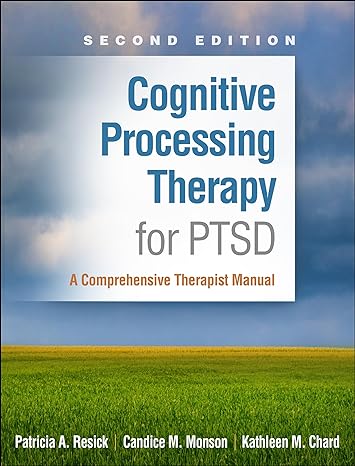
The CPT Manual
FREE Bonus with Registration ($55 value!)
Cognitive Processing Therapy for PTSD

Included in your registration is your own copy of Cognitive Processing Therapy for PTSD. It will be shipped to you after checkout. When you click the register button, be sure to select "Cognitive Processing Therapy for PTSD (Book)" under "Other great resources" to ensure the book is included with your registration.

You can get FREE SHIPPING for the book by adding promo code "CPTSHIP" on the Shipping Info screen at checkout in the "Discount Code" box on the right side of the screen.

**Please note: You will NOT have access to an archived version of this webinar after the program has ended.**

12 Sessions. Measurable Results. Clients Who Actually Heal.

July 13-14, 2026 • 8:00 AM - 4:00 PM ET

Live in Columbia, MD
Limited seats available – secure yours now

★ Two days LIVE training with Dr. Kathleen Chard
★ Breakfast and Lunch Included!
★ Up to 12.5 CE Hours
★ Hands on learning and personalized interactions
★ Network with your peers from across the country


$799.99 $599.99
Can’t Attend In-Person?
Join Us Live Online

★ Two days LIVE ONLINE training with Dr. Kathleen Chard
★ Join us from the comfort of your home
★ Up to 12.5 CE Hours
★ LIVE online Q&A
★ Virtual networking with colleagues across the country


$399.99 $199.99

Meet Your Expert

Kathleen M. Chard, PhD

Kathleen M. Chard, PhD, is a co-developer of CPT and director of the Trauma Recovery Center at the Cincinnati VA Medical Center. Serving as the VA CPT Implementation Director, Dr. Chard oversees the dissemination of CPT to mental health clinicians across the United States. She is the co-author of Cognitive Processing Therapy for PTSD: A Comprehensive Model (The Guilford Press, 2017) and author of CPT for Sexual Abuse Treatment Manual (2012). A sought-after speaker, Dr. Chard has personally trained over 5,000 clinicians throughout the United States on using CPT with veterans, active duty personnel, and civilians in addition to overseeing the training of tens of thousands of others via the trainers she supervises.

Click here for information about Kathleen M. Chard

Why Therapists Travel from Across the Country to Train with Dr. Chard

  • They want a trauma therapy that gives clients real choice—one that doesn't force people to talk about what happened to heal.
  • They want to learn from the source. Dr. Chard co-created CPT, has trained over 5,000 clinicians, and has tested this approach across every trauma type in 45 countries.
  • They want better outcomes—and they've seen the research proving evidence-based treatments actually deliver them.
  • They want answers about their "impossible" cases—TBI, substance use, personality disorders, suicidal ideation. The clients everyone said weren't ready.
  • They want to walk out confident they can actually help people heal—not just manage symptoms.

Event Location – Columbia, MD
 

Stay onsite at the DoubleTree by Hilton Columbia with indoor pool, hot tub, 24-hour fitness center, and onsite dining at 5485 Restaurant & Bar. Decompress after intensive training days with a walk around nearby Lake Kittamaqundi's peaceful 1.4-mile trail, or explore Columbia's excellent dining scene. You're also just 20 minutes from Baltimore and 40 minutes from Washington, D.C.


DoubleTree by Hilton Columbia
5485 Twin Knolls Road
Columbia, MD 21045
410-997-1060  


Frequently Asked Questions

This training is ideal if you:

  • Work with clients who have experienced trauma
  • Want an evidence-based approach with strong research backing
  • Have clients who struggle with traditional exposure-based therapies
  • Work with "complex" clients others have deemed "not ready"
  • Want practical, session-by-session tools you can use immediately
  • Prefer structured approaches that clients can learn to use independently

CPT has been successfully used with:

  • Veterans and active duty military
  • Sexual assault survivors
  • Survivors of childhood abuse
  • Clients with co-occurring substance use disorders
  • Clients with personality disorders
  • Clients experiencing suicidal ideation
  • Clients with TBI or cognitive impairments
  • Adolescents and adults across the lifespan

You don't need:

  • Previous CPT training
  • Extensive trauma therapy background
  • Your clients to be "stable" or "ready"


This conference is designed for:

 
  • Psychologists
  • Counselors
  • Social Workers
  • Addictions Professionals
  • Marriage & Family Therapists
  • Psychotherapists
  • Case Managers
  • Physicians
  • Other Mental Health Professionals

From Purchase Date until June 13, 2026: Cancellation results in a full refund less a $100 administrative fee

From June 14, 2026: Cancellation results in a 50% penalty of the total purchase amount


Event Countdown

0 Days
:
0 Hours
:
0 Minutes
:
0 Seconds

100% Satisfaction Guarantee
Register for this intensive training course without risk. If you're not completely satisfied, give us a call at 800-844-8260.

We’re that confident you'll find this learning experience to be all that's promised and more than you expected.

For live CE credit, you must attend the event in its entirety at its scheduled time and complete the CE quiz and evaluation within one week.

NOTE: No additional discounts or coupons may be applied to this event.
CBA/PLW95472 • © PESI Inc. • All rights reserved • Email: customersupport@pesi.com • Phone: 800-844-8260 • Questions? Visit our FAQ Page
Back to Top