
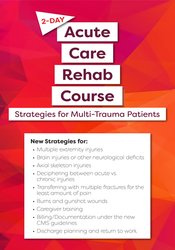
2-Day Acute Care Rehab Course
Strategies for Multi-Trauma Patients
- Speaker:
- Steven Rankin, OT/L
- Duration:
- 12 Hours 50 Minutes
- Format:
- Audio and Video
- Copyright:
-
Oct 30, 2019
- Product Code:
- POS063745
- Media Type:
- Digital Seminar

Description
In any acute or ICU setting, you’ve got to be ready to encounter any and everything when integrating rehab into the plan of care – particularly for patients with multiple traumatic injuries.
From establishing early mobilization when treating multiple extremity injuries to managing lines/wires/tubes to discharge planning and billing correctly under the new guidelines – acute and ICU rehab can be overwhelming and quite stressful, even for the most seasoned clinician.
Gain the confidence you deserve in the hospital setting by exploring new interventions for improving functional mobility, independence, and outcomes with your most challenging patients. Even if you already use some of the techniques, this recording refines your skills and goes a long way in making your work more efficient and effective.
Designed for all practice levels, from the new grad to the veteran acute care practitioner, this hands-on course will provide you with an updated knowledge base for making appropriate decisions within the ICU and acute care environments.
Gain age-appropriate strategies on how to best evaluate and treat patients with specific injuries, including multiple extremities, TBI, axial skeleton injuries, burns, and gunshot wounds – from acute to post-acute phases.
Credit
Handouts/Brochure
| File type | File name | Number of pages | |
|---|---|---|---|
| Manual - 2-Day Acute Care Rehab Course (27 MB) | 189 Pages | Available after Purchase |
Speaker
Steven Rankin, OT/L Related seminars and products
Steven Rankin, OT/L, has more than 20 years of experience as an acute care occupational therapist in an academic medical center, level 1 trauma and regional burn center, with a primary focus on trauma care. He left a career in the construction industry due to injury, which has provided him with a unique insight as a patient.
After many years of seeing continuing education available in specific content areas but not finding a comprehensive trauma course, he decided to create one himself. He has since trained physical and occupational therapy staff, speech-language pathologists, nurse practitioners, and medical doctors in the treatment of traumatic injuries. Mr. Rankin is a regular guest lecturer at the University of Wisconsin-Milwaukee in acute care.
Speaker Disclosures:
Financial: Steve Rankin receives a speaking honorarium and recording royalties from PESI, Inc. He has no relevant financial relationships with ineligible organizations.
Non-financial: Steve Rankin has no relevant non-financial relationships.
Additional Info
Access for Self-Study (Non-Interactive)Access never expires for this product.
Questions?
Visit our FAQ page at www.pesi.com/faq or contact us at www.pesi.com/info
Objectives
- Discuss the trauma care delivery system including your facility’s and profession’s role in that system.
- Articulate mechanisms of injury and specific implications for therapy.
- Identify incidence and prevalence of traumatic injury and death including important patient factors.
- Compare operative and non-operative management of injuries.
- Review case studies on acute rehab strategies for upper extremity injuries.
- Apply acute treatments for various upper and lower extremity injuries in lab session.
- Review various combinations of injuries and implications for treatment and co-treatment.
- Explain complications and how to prevent and to anticipate how to intervene.
- Determine therapy role in discharge planning and considerations for discharge destination/follow-up services.
- Describe the role of standardized and non-standardized assessments for planning of interventions and communication to other providers.
- Identify available resources and appropriate assessment in acute care.
- Review case studies determining when to co-treat patients with other professions.
Outline
OVERVIEW OF TRAUMA CARE DELIVERY SYSTEM- Trauma care centers
- Triaging algorithms
- Who gets hurt? How and why?
- Importance of what demographic information can tell us and how it can affect therapy
- How do client factors influence our decisions?
- What does it tell us?
- High vs. low impact injuries
- By trauma surgeon
- By consultants
- By therapists
- Case Studies
- Sepsis
- Drug and alcohol use
- Pulmonary embolism
- Pain
- Acute pain vs. acute on chronic pain
- Multi-modal approaches
SPECIFIC INJURIES AND ACUTE STRATEGIES FOR THE TREATMENT – CASE STUDIES AND LAB
FRACTURE MANAGEMENT
- Operative and non-operative treatments
- Indications for various treatments
- Wrist/hand
- Elbow, splinting considerations
- Shoulder – diagnosis, provocative tests
- Elbow trauma
- Burns
- TBI
- Facial fractures, Le Fort taxonomy
- TBIs
- Is it a brain injury?
- ETOH withdrawal
- Delirium
- Underlying dementia
- Rib fractures
- Spinal fractures
- Pelvic fractures
- Schatzker taxonomy
- Weber taxonomy
- Transfers and ambulation
- Weight bearing
- Amputations
- Splinting/orthotics/special cases
- Positioning, splinting
- Improve range of motion
- Precautions
- Fractures
- Soft tissue and vascular injuries
- Where do I start?
- Standardized assessment in the acute setting
- Balance/mobility
- ADL
- Functional cognition
- When do I co-treat?
- Caregiver training on c-collars, CTOs, TLOs and more
- Better billing and documentation under the new CMS guidelines
- Discharge planning and return to work recommendations
- How to dramatically reduce readmission
- Case Studies
Target Audience
- Physical Therapists
- Physical Therapists Assistants
- Occupational Therapists
- Occupational Therapy Assistants
- Nurses
- Nurse Practitioners
- Physician Assistants
Reviews
Satisfaction Guarantee
Your satisfaction is our goal and our guarantee. Concerns should be addressed to: PO Box 1000, Eau Claire, WI 54702-1000 or call 1-800-844-8260.
ADA Needs
We would be happy to accommodate your ADA needs; please call our Customer Service Department for more information at 1-800-844-8260.
PESI Mobile App
Access CE trainings on your phone or tablet through our free mobile app. Choose video or audio-only versions of online courses from the world’s best instructors, and complete your CE requirements anywhere, anytime, at your own pace.




Please wait ...